
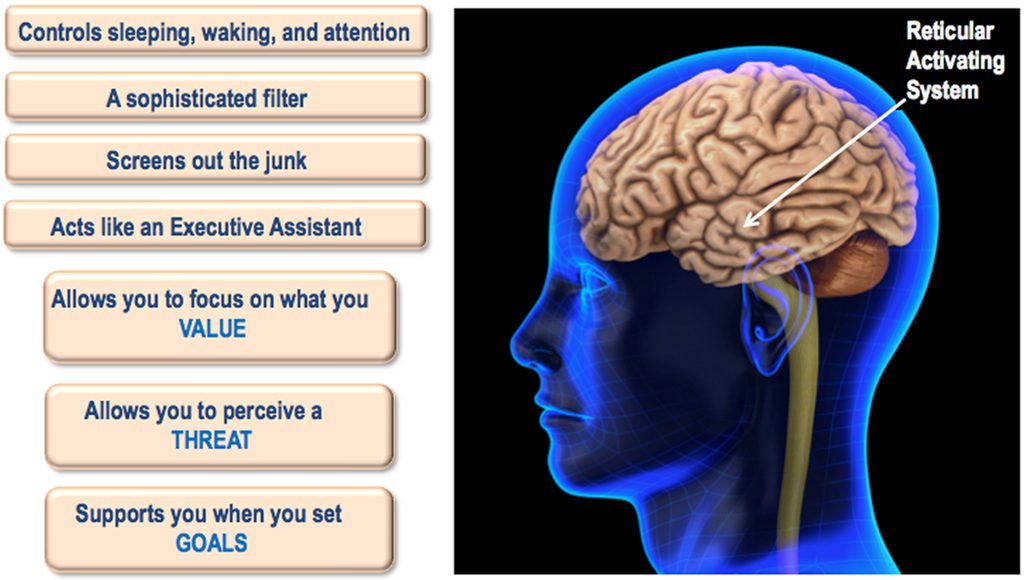
Your senses deliver around one billion bits of raw sensory data every second, but your conscious mind can process only 10–50 bits per second. Because of this enormous gap, the brain must filter almost everything. It uses a multi‑layered system — especially the Reticular Activating System (RAS) and the thalamus — to decide what gets through and what gets deleted.
The filtering process prioritises information based on:
- Survival relevance (threat, movement, sudden changes)
- Novelty (anything unexpected)
- Biological needs (pain, hunger, temperature)
- Emotional significance (fear, attachment, reward)
- Personal relevance (your name, your child’s voice, your goals)
Anything that does not meet these criteria is suppressed or deleted before you ever become aware of it.
The brain’s filtering is driven by two major forces working together:
- Survival relevance — hard‑wired, biological, automatic
- Learned relevance — shaped by knowledge, perception, childhood experiences, and beliefs
This combination determines what gets processed and what gets ignored.
A useful analogy is to think of the brain as a radio receiver. A radio receives millions of frequencies at once, but you only hear the station you are tuned to. The RAS acts like the tuning dial: it selects the “frequency” (information) that matters and filters out the rest.
Crucially, you can train your brain to tune differently. Through learning, repetition, and experience, you can change which information is filtered out and which information is considered important. This is the foundation of many subconscious‑mind training techniques, cognitive reframing, and attentional retraining.
Over time, these processes can influence how you interpret the world, how you respond to challenges, and how you experience emotions. While they are not a cure‑all, they demonstrate that the brain is plastic — it can be rewired to support healthier patterns of perception, attention, and emotional regulation.