What is the Secret of Successful People?

September 2026 – Farshad Farahnak. All rights reserved.

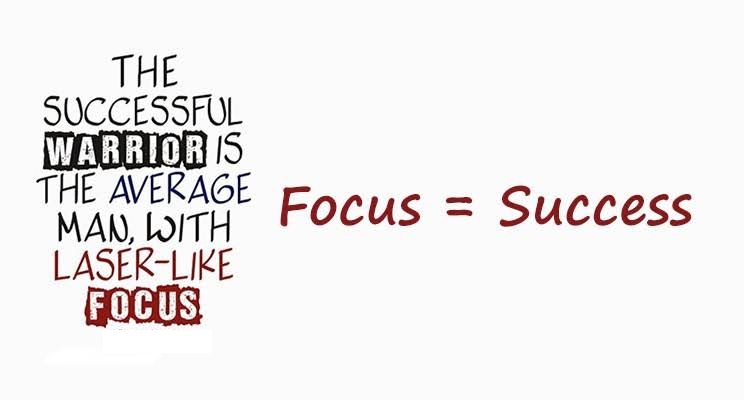
Become the Laser

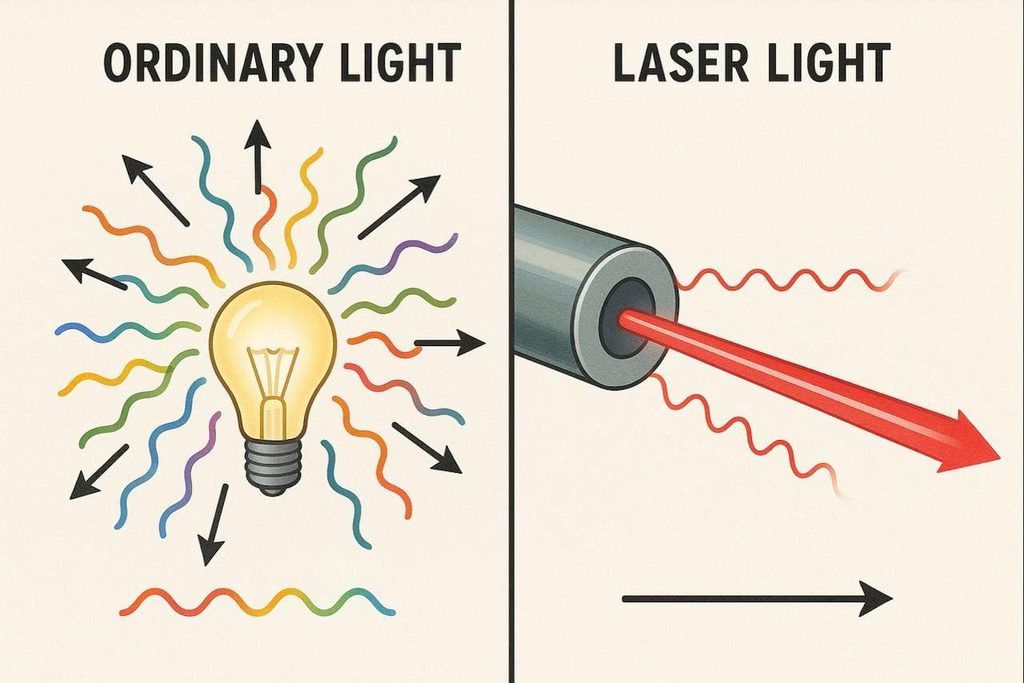
Most people have never stopped to notice the quiet difference between ordinary light and a laser.

A normal light — a bulb, a flashlight, the sun — releases photons in a messy, random way. The photons have different colours, leave at different times, and travel in every direction. Their waves are out of step with one another, like a crowd of people all walking and talking independently. Because of this disorder, the light spreads quickly. Its energy weakens fast with distance. Most of it is wasted lighting up space no one asked for. This is incoherent light.

A laser does the opposite. It forces the photons into order. Almost all of them share the same wavelength, travel in the same direction, and rise and fall in perfect rhythm. The result is a tight, coherent beam that stays narrow over long distances and keeps its intensity. When focused, that aligned energy becomes powerful enough to cut steel or reach the Moon.

That single difference — randomness versus alignment — changes everything.

Now look at the human mind.

Most people live like the lightbulb. Their thoughts scatter in every direction: worries about yesterday, fantasies about tomorrow, distractions, half-formed intentions, constant noise. Mental energy leaks out. Focus dilutes. By the time any real force reaches a goal, it has already weakened into almost nothing. They burn for a while, then fade. Distance defeats them.

A few people operate like the laser.

They refuse to scatter their thoughts and focus. They force their thoughts into coherence — same direction, same purpose, same rhythm. No wasted photons. Ordinary mental energy becomes a concentrated beam that can travel far without losing power. Obstacles that would have dispersed a diffuse mind simply meet focused intensity and yield.

This is the real distinction between the average and the exceptional.

It is not talent. It is not luck. It is not even raw intelligence. It is coherence — the decision to stop letting thoughts run wild and instead align them deliberately until they become a force.

When your mind is aligned, you stop being a passenger. You become the source. Time stops slipping away and starts moving under your direction. You shift from consuming the world to shaping it. You move from hoping things will happen to making them happen.

This is practical, not mystical. Attention is the only instrument you fully control. Treat it the way a laser treats light.

Start small. Choose one clear target. Notice every time your mind drifts and bring it back — not with force, but with quiet insistence. Protect the beam. Refuse the noise that tries to pull your thoughts out of phase. Over time, the alignment strengthens. What once required constant effort begins to feel natural. The laser stabilises.

Then watch what happens.

Distance no longer dilutes you. Intensity compounds. You stop wishing you were the kind of person who finishes things and become the kind of person who does.

The world is full of lightbulbs — bright for a moment, quickly forgotten.

Be the laser.

Align your thoughts.
Focus your energy.
Create.

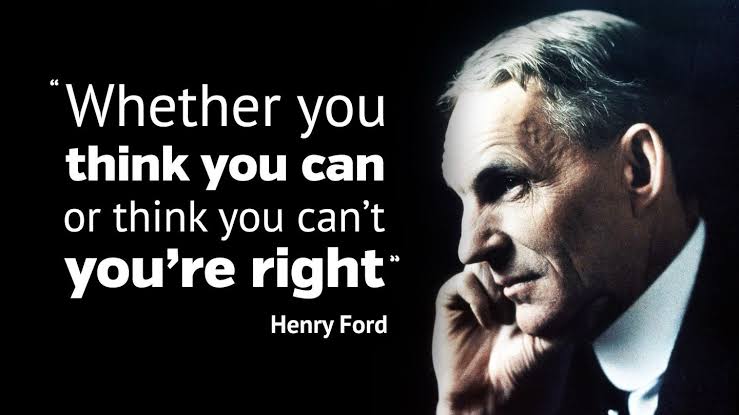
Whether You Think You Can or You Can’t, You Are Right

Henry Ford’s line is simple, almost blunt: Whether you think you can or you can’t, you are right. It is not motivational fluff. It is a quiet description of how the mind actually works.

Your brain is a confirmation machine. It does not neutrally collect facts and then decide. It starts with a belief and then gathers evidence that protects that belief.

When you decide “I can’t,” the mind goes to work defending the decision. It highlights every obstacle, every past failure, every reasonable-sounding excuse. The path looks closed because you have already told it to look for closed doors.

When you decide “I can,” the same machinery switches direction. Suddenly the same obstacles become problems to solve. Resources appear that were invisible before. People, ideas, small openings, and awkward first steps start to register. The path does not magically become easy—it simply becomes visible.

This is why mindset is not a soft extra. It is the filter that determines what reality you are allowed to see. Two people can face the identical situation. One will list reasons it is impossible. The other will start looking for the next workable move. Both will feel certain they are being realistic. Both will be right—about the world their belief has constructed.

The practical implication is almost uncomfortable in its simplicity: the first and most important work is not on the external problem. It is on the quiet sentence you keep repeating to yourself.

Change the sentence, and the evidence begins to rearrange itself. Solutions that were previously filtered out start to show up. Effort that once felt pointless starts to compound. Progress that looked impossible begins to look merely difficult—and difficult is something you can work with.

You do not have to feel confident to begin. You only have to stop insisting that you can’t. The moment you allow the possibility that you can, your mind is forced to start proving it. And once it starts looking for proof, it usually finds some.

That is the quiet power of the quote. Not that positive thinking makes everything easy, but that the decision about what is possible is made long before the work begins—and that decision is largely under your control.

Think you can, and you will begin noticing the ways.
Think you can’t, and you will keep finding the reasons.

Either way, you are right.

Childhood Trauma, Reality or Trend?

September 2026 – Farshad Farahnak. All rights reserved.

You Can’t Avoid the Scratches: Why Trauma Is Part of a Meaningful Life

There’s a strong current these days around childhood trauma. We’re told how formative it is, how it shapes us, how important it is to acknowledge, process, and heal from it. All of that has value. Ignoring real wounds doesn’t make them disappear.

But here’s what my own experience and observation keep pointing to: you can’t live a human life without trauma. We are here, in part, for the same reason. Without pain, stress, and the inevitable hard edges of existence, life loses much of its meaning. A life engineered to be perfectly smooth risks becoming empty.

Consider the classic “utopia” experiments with mice, particularly John B. Calhoun’s Universe 25. Researchers created an environment of near-total comfort: unlimited food and water, no predators, no disease, nesting materials, and protection from the usual threats of the wild. The mice had everything they needed for physical survival. At first, the population thrived. Then, over time, things unravelled. Social behaviours broke down. Aggression rose in some, withdrawal and listlessness in others. Maternal care deteriorated. A group of mice Calhoun called “the beautiful ones” spent their days mostly grooming, eating, and sleeping, detached from normal social and reproductive life. Depression-like states and dysfunctional patterns emerged even though every material need was met. The colony eventually collapsed into decline despite the abundance.

Comfort without challenge, purpose, or the friction of real life did not produce flourishing. It produced a kind of behavioural and social disintegration. The absence of necessary struggle did not create paradise; it hollowed things out.

Now think about a more ordinary example: buying a new car. It arrives fresh, unmarked, free of scratches or dents. You drive it. Over the years, accidents happen—some your fault, some someone else’s, some simply the result of being on the road. A few may be minor; others can feel devastating. Sometimes you forgive; sometimes you are forgiven. The body of the car accumulates marks. The same process happens to our bodies, minds, and souls across a lifetime. From childhood onward, life leaves its scratches, scuffs, and deeper bends. We cannot avoid them all the way to the end.

Taking care of the car—regular maintenance, repairs, careful driving—matters enormously. It can keep the vehicle running well and prevent worse damage. Yet no amount of care returns it to brand-new condition if you live with it for decades. The history remains visible. What changes everything is how we respond when the damage occurs.

We can answer a scrape or a collision with road rage: escalating the harm, numbing it with substances, or turning the pain outward or inward in ways that create more wreckage. Or we can choose a different response—repair what can be repaired, learn from the impact, adjust how we drive going forward, and keep moving with greater awareness. The scars stay. The meaning of the journey, and the quality of the life lived inside that vehicle, depends heavily on the reaction.

Trauma is not optional. It is woven into the fabric of being alive. What is optional—and decisive—is how we meet it. The point is not to romanticise suffering or to dismiss the real work of healing. The point is to stop treating the existence of pain itself as the ultimate failure, and to recognise that our responses shape whether those experiences leave us broken or deepen our capacity to live fully.

We are not meant to arrive at the end of the road looking factory-fresh. We are meant to arrive having driven it—scratches and all—with some wisdom about how to handle the next turn.

Remember:

No one is coming to save you.

There is no such thing as a life without problems or pain.

Everything worth having comes with an inherent sacrifice.

Whatever makes you feel good will eventually also make you feel bad.

The only real failure is not trying; the only real rejection is not asking.

You give power to whoever (or whatever) you blame.

Your relationship with others is a direct reflection of your relationship with yourself.

Respect is earned through what you do, not given because you exist.

You will always feel mildly inadequate and somewhat dissatisfied—and that’s normal.

The person you marry is the person you fight with; the house you buy is the house you repair; the life you choose is the life you must maintain.

What is Gaslighting

Gaslighting is a form of psychological manipulation in which a person or group causes someone to question their own perceptions, memories, sanity, or reality.

The term originates from the 1938 stage play Gas Light (and its 1940/1944 film adaptations), in which a husband systematically manipulates his wife—by dimming the gas lights in their home and then denying that the lights have changed—into doubting her own senses and believing she is going mad.

Core features

  • The manipulator repeatedly denies, contradicts, or reframes events, facts, or feelings that the target has experienced.
  • The goal (conscious or not) is to erode the target’s confidence in their own judgment so the manipulator gains control, avoids accountability, or maintains power in the relationship.
  • It often occurs in intimate relationships, families, workplaces, or other settings involving an imbalance of power, but it can also appear in broader social or political contexts.

Common tactics

  • Flat denial of things that happened (“That never occurred” / “You’re imagining it”).
  • Trivialising the other person’s feelings (“You’re overreacting” / “You’re too sensitive”).
  • Shifting blame onto the target.
  • Withholding information or refusing to engage (“I don’t know what you’re talking about”).
  • Using others to reinforce the false narrative (e.g., “Everyone agrees with me that you’re unstable”).

Effects

Targets may begin to second-guess themselves constantly, feel confused or “crazy,” lose trust in their own memory and judgment, become overly dependent on the manipulator for “reality checks,” experience anxiety or depression, and have difficulty making decisions.

Gaslighting is distinct from ordinary disagreement, forgetfulness, or differing perspectives; it is a pattern of deliberate or habitual distortion aimed at undermining another person’s sense of reality. Awareness of the pattern is often the first step in recognising and addressing it.

How to Protect

Protecting yourself from gaslighting centres on strengthening your trust in your own perceptions, reducing the manipulator’s influence, and building external support.

1. Recognise the pattern early

  • Notice repeated denials of things you clearly experienced, dismissal of your feelings as “overreacting,” or attempts to make you doubt your memory.
  • Track how interactions leave you feeling confused, anxious, or “crazy.” That emotional residue is often a useful signal.

2. Anchor yourself in reality

  • Keep private records (notes, screenshots, dates, what was said/done). Written evidence counters “that never happened.”
  • Trust your senses and memory first. You do not need the other person’s agreement for something to be real.
  • When possible, check facts with neutral third parties or objective sources rather than relying solely on the person gaslighting you.

3. Set and enforce clear boundaries

  • State what behaviour is unacceptable (“When you deny something we both experienced, I will end the conversation”).
  • Follow through consistently. Repeatedly engaging with the distortion often feeds the dynamic.
  • Limit the information you share about your doubts or vulnerabilities; gaslighters frequently use that material against you.

4. Reduce isolation

  • Maintain relationships outside the problematic dynamic. Isolation makes gaslighting more effective.
  • Talk to trusted friends, family, or colleagues about specific incidents (not just vague feelings). Outside perspectives help recalibrate your sense of reality.
  • Consider professional support (therapist, counsellor) experienced with emotional abuse or coercive control if the situation is ongoing or severe.

5. Limit or end contact when necessary

  • In relationships where the pattern is persistent, and the person refuses to change, the strongest protection is often distance or no-contact.
  • In workplaces or family situations where full exit is difficult, minimise one-on-one interactions, document everything, and use formal channels (HR, mediation) when appropriate.

6. Strengthen your internal resources

  • Practice self-validation: regularly affirm what you know to be true about events and your feelings.
  • Reduce dependency on the gaslighter for emotional regulation, decision-making, or self-worth.
  • Prioritise sleep, physical health, and activities that reinforce your competence and autonomy.

Gaslighting thrives on confusion and self-doubt. The most effective protection is steady self-trust backed by evidence, boundaries, and external reality checks. If the situation involves ongoing emotional abuse, safety planning or professional guidance is often warranted.

Overthinking Is Not Wisdom—It’s a Trap Disguised as Thinking

There’s a quiet difference most of us never notice until it costs us something real.

Deep, analytic thinking is deliberate. It examines evidence, weighs possibilities, and then returns to the present so you can act. It ends in a meaningful decision. Deep, analytic thinking works differently. It prioritises structure, evidence, and consequence over emotional colouring. It asks: What actually happened? What is the causal chain? What options remain open? Emotion is not entirely absent — values, motivation, and even a quiet sense of care can guide the inquiry — but it does not hijack the process. Feeling is treated as data rather than as the driver. The mind stays oriented toward reality instead of toward the private theatre of what might have been or what could still be.

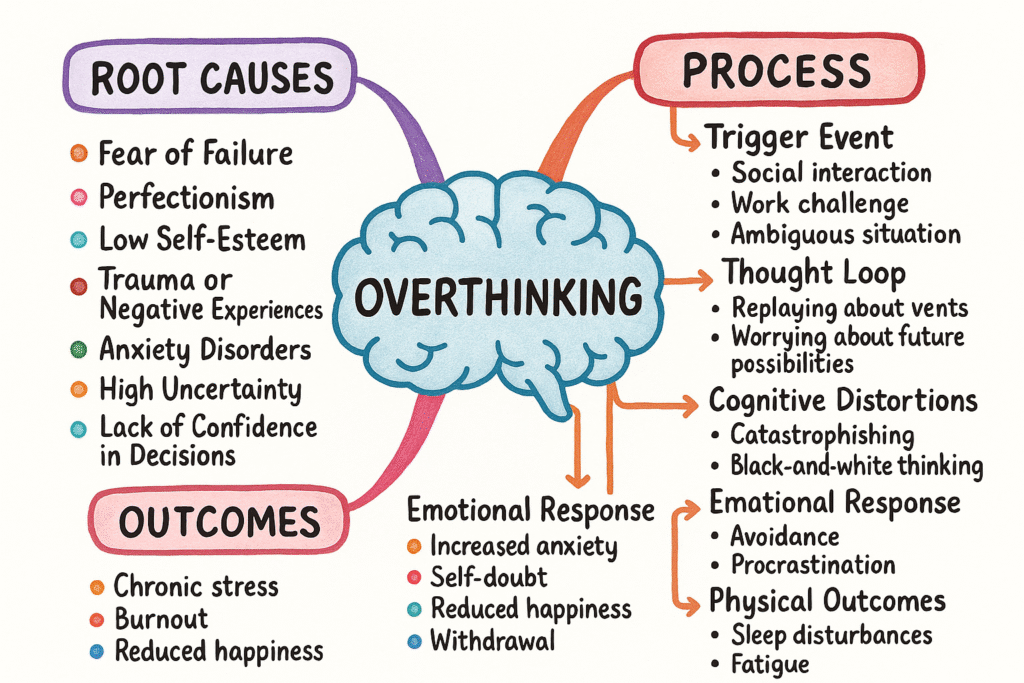
Overthinking is something else entirely. It is looping. It is rehearsal. It is the mind spinning endless versions of what already happened—or what might still happen—until the original event becomes almost unrecognisable. Overthinking is rarely pure thought. It is thought saturated with feeling. The mind doesn’t simply examine an event; it bathes it in emotion — anxiety, regret, longing, imagined triumph, or dread — until the original facts become secondary. The scenarios feel compelling precisely because they are emotionally charged. The loop continues because the feelings keep feeding it. In that sense, overthinking is polluted: logic is present, but it is subordinated to emotional intensity. The result is not clearer understanding but amplified distortion.

So the contrast holds:

  • Overthinking = thought + emotional contamination → looping, exaggeration, poor decisions.
  • Deep thinking = thought guided by logic and reality-testing → clarity, proportion, better action.

The practical implication is useful. When you notice yourself rehearsing, ask not only “Am I thinking or ruminating?” but also “How much of this is emotion wearing the mask of thought?” That single question often breaks the spell. It returns you to the cooler, more useful mode of mind — the one that can still feel without being ruled by feeling.

You know the pattern. Something occurs: a conversation, a decision, a moment of praise or criticism. Instead of letting it settle, the mind takes possession of it. It builds alternate endings. It invents dialogues you never had. It stages victories in which you finally said the perfect thing and watched others concede. Or it stages defeats in which everything collapses, and you are left exposed. In that private theatre you fight, win, lose, celebrate, and grieve—sometimes all in the same hour. The emotional intensity feels significant. It feels like processing. But it is not. It is consumption.

Like any addiction, it delivers a temporary hit—relief, righteousness, imagined control—while slowly eroding the ground under your feet. The scenarios feel vivid because they are fueled by real emotion, yet they remain fictional. Decisions made from that fog are rarely clear. You react to a story rather than to reality. And because the mind has rehearsed certain reactions so thoroughly, those responses begin to migrate into automatic systems. The next time a similar situation appears, the script runs before you consciously choose. A sharp word, a defensive posture, a withdrawal that no longer matches the actual moment. Life starts answering a version of events that only existed inside your head.

This is not insight. It is distortion with good marketing.

The way out is not to stop thinking. It is to notice the difference between thinking that serves life and thinking that feeds on itself. When the familiar loop begins—when you catch yourself replaying, rewriting, or winning arguments that never happened—pause long enough to ask a simple question: Is this helping me meet reality, or is it keeping me inside a story?

That small act of recognition is already a return. From there you can choose: gather the actual facts, feel the real emotion without embroidery, and then decide what, if anything, needs to be done in the world that exists outside your mind.

Awareness does not eliminate the impulse overnight. The mind is practised at this particular form of self-occupation. But every time you interrupt the loop, you weaken its claim on you. You reclaim the difference between reflection and rumination. You protect the quality of your decisions. And you stop letting imagined battles quietly become real consequences.

The next time the mind starts building its private stage, remember: the most powerful thing you can do is simply refuse to buy a ticket. Step back into the actual moment. That is where your life is still waiting for you—unscripted, unfinished, and still capable of being lived rather than merely rehearsed.

Criticism Is Easy. Contribution Is Rare.

A famous painter once wanted honest feedback on his work. One morning he carried one of his finest paintings into a crowded public square and placed a simple note beneath it:

“If you find any mistake in this painting, mark it with a cross.”

When he returned at the end of the day, his heart sank. The painting was covered in crosses. Almost every detail had been criticised. Discouraged, he took the painting to a close friend and said, “Perhaps I am not as talented as I thought.”

His friend smiled gently. “Do not lose hope. Paint the exact same picture again without changing a single thing. Tomorrow we will try something different.”

The next morning they placed the identical painting in the same square. This time the note read:

“If you find any mistake, please correct it. Brushes and paints are provided.”

When the painter returned that evening, the canvas was untouched. Not one person had lifted a brush.

His friend looked at him and said:

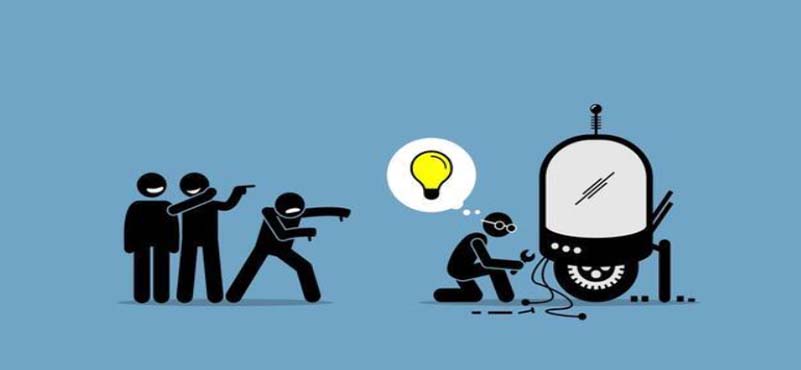
“People are always ready to point out what is wrong, but very few have the knowledge, courage, or ability to make it right. Criticism is easy. Contribution is difficult.

So before you allow someone’s opinion to define your worth, ask yourself one question: Can they offer a better solution, or are they simply pointing at the problem?”


We live in a world overflowing with critics. Comments, reviews, side-eye glances, and casual remarks arrive daily, often from people who have never attempted the work themselves. It is easy to spot a flaw. It costs almost nothing to mark a cross.

But offering a real solution? That requires skill, humility, time, and courage. Most people will never pick up the brush.

The next time someone’s criticism lands heavily on you, pause. Ask the quiet question the painter’s friend taught him. If the person cannot (or will not) offer something better, their opinion does not deserve the power to shrink your confidence or dim your vision.

Protect your creative energy. Keep painting. And when you do offer feedback to others, try to bring the brush—not just the cross.

Because the world already has enough critics.
What it needs more of are people willing to contribute.

The Invisible Picture Running Your Life – Self-Image

And the 60-year-old book that still exposes it better than almost anything written since

Have you ever stopped and really asked yourself who you actually are?

Not your name. Not your job. Not the roles you play for other people. The thing underneath all of that.

Most of us go our entire lives without seriously questioning that inner picture. Yet that picture—the invisible self-portrait we carry—quietly shapes nearly every outcome in our lives: our income, our relationships, our health, how far we go, and how quickly we stop. It runs in the background like software we never installed and can’t see.

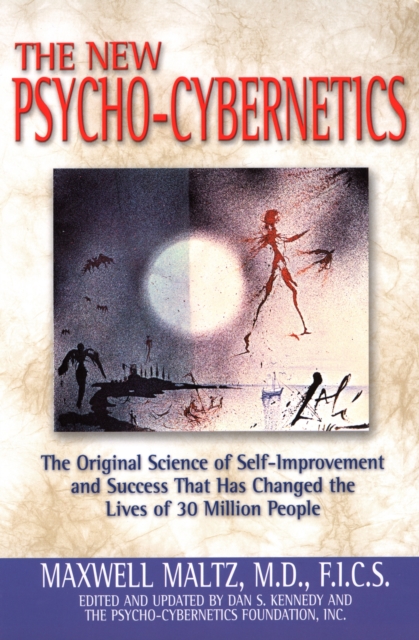
Over sixty years ago, a plastic surgeon named Maxwell Maltz wrote a book that makes this system visible in a way that is still unsettling. The book is called Psycho-Cybernetics. Once you understand what it is saying, it becomes difficult to look at your own limits the same way again.

The Observation That Changed Everything

Maxwell Maltz was one of the most skilled plastic surgeons of the mid-20th century. He rebuilt faces damaged by accidents, war, and birth defects. After thousands of operations, he noticed something that broke his assumptions.

Some patients were transformed the moment the bandages came off. Their posture changed. Their voice changed. They carried themselves differently in a room. The new face seemed to give them permission to become a different person.

Others walked out with objectively improved faces—confirmed by photographs—and still felt ugly. Still felt broken. Still behaved exactly as they had before surgery. The outer face had changed. The inner one had not moved an inch.

Maltz concluded that the surgery that actually determined a person’s behaviour, results, and ceiling was not the one performed with a scalpel. It was the surgery happening in the mind, in what he called the self-image.

Every person carries an internal portrait of themselves. All behaviour—every decision, every risk taken or avoided, every relationship allowed—is calibrated to match that portrait. You do not consistently perform above your self-image. You can get lucky once. Sustained results always find the ceiling the self-image defines.

The Ceiling Is Not Outside You

This is the uncomfortable realisation the book forces: the mechanism is not external.

As children, we are highly impressionable. We absorb what the people around us say about us and file it as truth. “You’re clumsy.” “You’re not the smart one.” “You’re weird.” These statements calcify into the self-image that then quietly runs our adult lives for decades.

Maltz borrowed language from a then-new science—cybernetics—to explain how this works. Cybernetics studies self-regulating systems: thermostats, guided missiles, anything that locks onto a target, senses deviation, and automatically corrects course.

The human mind, Maltz argued, works the same way. It is a goal-seeking mechanism. It steers toward its target automatically, below conscious awareness. The critical point is that the target is not necessarily what you want. It is what your self-image defines as what you are.

If your self-image says you are someone who earns a certain amount, has a certain kind of relationship, or reaches a certain level of success, the system steers toward that picture with remarkable precision. When life tries to push you above it, the system corrects and pulls you back—not because you are weak or lack willpower, but because the machine is working exactly as designed. It is simply aimed at the wrong target.

Changing the Target

Maltz’s answer for updating the self-image is not willpower, discipline, or grinding harder. The same mechanism that built the self-image—felt experience—can change it.

The nervous system cannot reliably distinguish a vividly imagined experience from a real one. Therefore, if you construct clear, detailed, emotionally felt mental rehearsals of yourself already performing as the person you want to become, the nervous system begins logging those experiences as data. Maltz called this the theatre of the mind.

This is not mystical. It is closer to how elite athletes have trained for decades. Mental rehearsal is a well-documented tool in performance psychology. Maltz was simply decades ahead of the formal research.

The most important step, however, is not the technique itself. It is first recognising that a self-image exists at all and that it is operating. Most people who struggle with results keep changing strategies, plans, and environments while the underlying picture remains untouched. You can rearrange everything on the surface and still hit the same ceiling.

How to Practice It

Maltz’s practical method begins with deliberate relaxation—not passivity, but a downshifting of the nervous system into a more receptive state, similar to the edge between waking and sleep. In that state, the critical mind loosens its grip, and mental images land more deeply.

From there you construct a specific, sensory, emotionally real scene in which you are already the person you intend to become. Not hoping to become. Already are. You see through your own eyes. You feel it in your body. You hold the scene long enough for it to register as experience rather than fantasy.

This is not a one-time intervention. The original self-image was built through years of repetition. It changes through consistent daily practice. Over time, the system recalibrates and begins steering toward the new picture the same way it once steered toward the old one.

Why the Book Still Matters

Psycho-Cybernetics has sold more than 30 million copies since 1960. It has influenced athletes, coaches, and high performers across industries—not because it is soft self-help, but because it named a real mechanism and offered a practical framework for working with it. The ideas remain operational more than six decades later.

The book is “dangerous” in one specific sense: once you see that an invisible system is setting your ceiling, that the system was largely written by other people when you were too young to evaluate it, and that you have never seriously examined what it says, the realisation is uncomfortable. That discomfort is useful. You cannot change what you cannot see.

The question is not whether you have a self-image. You do. The question is whether the picture you are carrying matches the life you are trying to build. If it does not, strategy alone is just rearranging furniture on a foundation that has not changed.

The real work is going to the picture itself—examining what is actually in it, and deciding, deliberately, to change it.

Most people never do.

Who Should You Really Learn From?

August 2026 – Farshad Farahnak. All rights reserved.

When I started my martial arts journey, I thought the person teaching me already knew everything I needed. I was wrong — and that mistake taught me one of the most valuable lessons of my life.

In the beginning, the grandmaster almost never trained the new students. Higher-ranked students did. They showed us the stances, the punches, the kicks, and the basic techniques. We practised hard. Those techniques worked. They worked against other beginners. They worked against people who had no experience. For a while, I believed I was learning the real thing.

Then, slowly, I started training more directly with the grandmaster. Suddenly the same techniques looked different. Small details appeared that no one had shown me before. Tiny adjustments in timing, structure, and body movement changed everything.

One clear example was punching. At first I was taught to punch mostly with my arm. It felt strong. It worked on people at my level. Later I learned the truth: power does not come from the arm alone. It comes from the rotation of the whole body, the transfer of weight, and the coordinated movement of the hand. The earlier version was incomplete. It was good enough for beginners. It failed against black belts and in real competition.

That experience stayed with me.

Here is the simple rule I learned:

Learn from people who have already walked the same path and reached the goal you want.

They know what actually works when it matters. They have already faced the problems you will face. They understand the difference between something that “works in the beginning” and something that still works under pressure.

But there is an important reality: when you are a complete beginner, you usually cannot reach those people yet. You start with intermediates — higher students, junior colleagues, online teachers who are only a few steps ahead. That is normal. Just remember that what they teach you is often incomplete. It is a useful starting point, not the final version.

This is not only true in martial arts. It is true in almost every area of life.

When you start a business, early advice from other early-stage founders or general coaches can get you moving. Many of those methods work when the stakes are low. Later, you discover that the people who have actually built and scaled successful companies use different approaches. They see risks and opportunities the intermediates miss.

When you learn a professional skill — programming, sales, design, writing, public speaking — or when you build a business, the same pattern appears. You often begin with tutorials, colleagues, or mentors who are only a few steps ahead of you. Their methods can help you grow. They may even help you build a business to £100,000 a year. At that stage, the advice works.

But if you want to go further — to £1,000,000 and beyond — the rules change. The skills that got you to the first level are no longer enough. The challenges become different. The decisions become more complex. You need new knowledge and a different level of guidance. You need people who have already built businesses at that larger scale — the “grandmasters” of that stage.

And when you pass the next milestone, you will need yet another level of insight. The person who helped you reach £1,000,000 may not be the right guide for the next leap. You will need to find the next grandmaster.

Growth is not about finding one perfect mentor and staying with them forever. It is about matching the level of the teacher to the level of the goal you are currently chasing — and being willing to move on when you outgrow what they can give you.

So here is the practical takeaway:

Be grateful for every mentor who helps you start.
Respect the foundation they give you.
But do not stop there.

Keep looking for people who have already reached the specific goal you are aiming for at each stage of your journey. Learn from them. Be ready to refine, correct, and sometimes completely rebuild what you learned before.

The path is not a straight line from zero to mastery. It is a series of better and better versions of the truth — and a series of better and better guides.

Start where you are. Learn from whoever is available. And never stop seeking the people who have already arrived where you want to go next.

That is how real growth happens — in martial arts, in business, and in life.

Why Do People With ADHD Often Struggle With Structure and Rigid Planning?

One of the most puzzling experiences for many people with ADHD is the tension between loving the idea of structure and feeling trapped when they actually try to follow it. To understand why this happens, it helps to look at how the brain responds to reward, motivation, and predictability.

The Science Behind Motivation: A Lesson From B.F. Skinner

In the 1940s, American psychologist B.F. Skinner conducted a series of experiments to understand how complex behaviours could be taught to animals. He successfully trained pigeons to perform surprisingly intricate tasks—like pecking a specific spot a number of times that was a multiple of three in order to earn a reward.

But there was a problem: once the pigeons mastered the task, their motivation quickly faded. They simply lost interest.

Skinner discovered a solution that changed everything: random rewards.

Instead of receiving a predictable amount of food each time, the pigeons sometimes got a lot, sometimes got nothing, and sometimes got just a little. Because they couldn’t predict the outcome, their motivation stayed high. They kept pecking, driven by the possibility that this time might be the big reward.

If this sounds familiar, it’s because the same mechanism underlies gambling. Random rewards create powerful anticipation, which can keep people engaged even when the outcomes are consistently negative.

What Does This Have to Do With ADHD?

People with ADHD often have an underactive dopamine system. Dopamine is closely tied to motivation, anticipation, and the feeling of reward. One of the most reliable ways to increase dopamine is through expectation—the sense that something good is coming.

Think of how Thursdays often feel better than Fridays. On Thursday, the brain anticipates the upcoming break. On Friday, the excitement has already passed.

For many people with ADHD, the same principle applies to daily life. When they know exactly what will happen throughout the day, the sense of anticipation disappears. Predictability reduces dopamine. As a result:

  • Planning feels exciting.
  • Execution feels flat, heavy, and unmotivating.

This is why rigid structure can feel suffocating. Too much predictability means too little dopamine.

So How Can People With ADHD Work With Their Brain Instead of Against It?

The goal isn’t to eliminate structure—it’s to use the right kind of structure.

1. Avoid Hour‑by‑Hour Schedules

Highly detailed daily plans often fail because they remove all unpredictability. The brain sees the entire day as already “known,” and motivation drops.

2. Use Short, Simple Frameworks

The Pomodoro Technique is a great example: 25 minutes of work, 5 minutes of rest. Only the next 25 minutes are predictable, which keeps dopamine from crashing.

3. Add Playfulness and Challenge

Tasks that require focus become easier when they feel like a game. You can:

  • Set mini‑challenges
  • Make bets with yourself
  • Race against a timer
  • Turn the task into a puzzle

For example: “Can I read this page in one minute?”

People with ADHD are naturally good at gamifying boring situations—this is a strength worth using.

4. Include an Unstructured Block in Your Day

During this time, simply write down your tasks without deciding:

  • which one comes first
  • what time each should happen
  • how long each should take

This preserves a sense of freedom and spontaneity, which helps maintain motivation.

Why Most of What You Do Happens Without Thinking

August 2026 – Farshad Farahnak. All rights reserved.

Why do most of us react impulsively in many situations?

Why is thinking so hard for many of us?

Imagine you accidentally touch a hot stove.

In a fraction of a second, your hand jerks away. You didn’t decide to pull back. You didn’t weigh the options, check your memory for past burns, or consciously conclude “this is dangerous.” The movement happened first. Only afterwards did the conscious thought arrive: “That was hot. That hurt.”

That split-second reaction is your nervous system’s autopilot at work. And it is far more common than most of us realise.

The Fast Path: Reflexes That Don’t Wait for Permission

Some protective actions never need the higher parts of the brain at all. The classic withdrawal reflex from intense heat or pain is handled largely at the spinal-cord level. Sensory signals travel into the spinal cord, connect through interneurons, and immediately send motor commands back out to the muscles. The whole loop can finish in well under a tenth of a second.

Higher centres (brainstem, cerebellum, and cortex) can modulate or refine these responses, but the initial protective action is designed to be fast and local. Evolution favoured speed over perfect accuracy. Better to yank your hand away from something that might be dangerous than to wait for a full conscious evaluation and risk serious injury.

Of course the system is not flawless. Extreme cold can occasionally trigger a similar protective pull, or a sudden intense sensation can be momentarily misread. A few seconds later conscious awareness catches up, and you realise the object was simply very cold, not burning. The reflex still served its purpose most of the time: it erred on the side of safety.

The Slow Path: Conscious Thinking Is Expensive

Contrast that with full conscious processing. Information has to travel farther, be compared with existing memories, evaluated against goals and risks, and then translated into a deliberate decision. That process is slower, more flexible, and metabolically costly. The brain accounts for a disproportionate share of the body’s energy use, and the networks involved in deliberate reasoning and self-control are especially hungry.

This is why so much of daily life runs on autopilot. Walking a familiar route, driving a well-known commute, typing on a keyboard, or reaching for your coffee in the morning can all happen with minimal conscious oversight. Once a pattern has been repeated enough times, the brain shifts control toward more efficient circuits. What once required focused attention becomes smoother, faster, and eventually almost effortless—sometimes even possible with your eyes closed.

Why We Default to Autopilot (and the Crowd)

Active thinking takes energy and a certain amount of psychological effort. Faced with that cost, most people prefer routines. Routines feel safe, predictable, and cheap. The same principle helps explain why we so readily follow the crowd. When many people around us are doing something, treating their behaviour as a ready-made answer is often easier than independently analysing the situation. Social conformity can function as another form of cognitive autopilot.

None of this means conscious thought is rare or unimportant. It means the brain is economical. It reserves the expensive, flexible mode for novelty, complexity, or high-stakes decisions, and lets practised patterns run in the background the rest of the time.

From Awkward to Automatic: How New Skills Change

Watch someone learn a new physical or cognitive skill—playing an instrument, driving a car, speaking a foreign language, or even navigating a new software interface. At first every step demands attention. Performance is slow, effortful, and error-prone. With repetition, the same actions become smoother. Attention can be redirected elsewhere. Eventually the skill can feel almost unconscious.

This transition from controlled to automatic processing is one of the brain’s most useful features. It frees limited conscious resources for the next novel challenge.

Conclusion: Why We Cling to the Familiar and Sometimes React First, Think Later

This is also why so many of us prefer repeated tasks and quietly resist change or new learning. Once the brain has wired a reliable autopilot program, sticking with it feels effortless. Learning something new, or deliberately altering a habit, forces the system back into the costly, attention-demanding mode. Avoiding that effort is not laziness in the moral sense—it is the brain doing what it evolved to do: conserve energy.

The same wiring explains many impulsive reactions. Because the brain gradually strengthens the pathways it uses most, certain emotional or behavioural responses become automatic. We snap, withdraw, agree, or act before the slower conscious system has time to evaluate whether that response is actually the best one. Only afterwards do we realise a more measured reaction would have served us better.

The autopilot is not the enemy. It keeps us safe, efficient, and functional. The practical skill is recognising when it is running an outdated or suboptimal program—and choosing, in those moments, to spend the energy required to override it.