
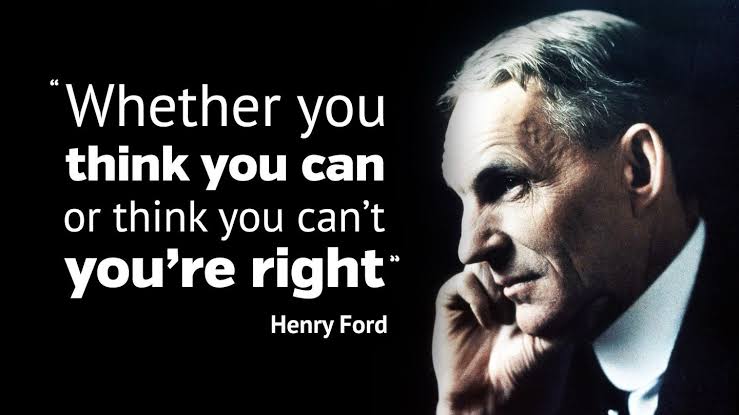
Henry Ford’s line is simple, almost blunt: Whether you think you can or you can’t, you are right. It is not motivational fluff. It is a quiet description of how the mind actually works.
Your brain is a confirmation machine. It does not neutrally collect facts and then decide. It starts with a belief and then gathers evidence that protects that belief.
When you decide “I can’t,” the mind goes to work defending the decision. It highlights every obstacle, every past failure, every reasonable-sounding excuse. The path looks closed because you have already told it to look for closed doors.
When you decide “I can,” the same machinery switches direction. Suddenly the same obstacles become problems to solve. Resources appear that were invisible before. People, ideas, small openings, and awkward first steps start to register. The path does not magically become easy—it simply becomes visible.
This is why mindset is not a soft extra. It is the filter that determines what reality you are allowed to see. Two people can face the identical situation. One will list reasons it is impossible. The other will start looking for the next workable move. Both will feel certain they are being realistic. Both will be right—about the world their belief has constructed.
The practical implication is almost uncomfortable in its simplicity: the first and most important work is not on the external problem. It is on the quiet sentence you keep repeating to yourself.
Change the sentence, and the evidence begins to rearrange itself. Solutions that were previously filtered out start to show up. Effort that once felt pointless starts to compound. Progress that looked impossible begins to look merely difficult—and difficult is something you can work with.
You do not have to feel confident to begin. You only have to stop insisting that you can’t. The moment you allow the possibility that you can, your mind is forced to start proving it. And once it starts looking for proof, it usually finds some.
That is the quiet power of the quote. Not that positive thinking makes everything easy, but that the decision about what is possible is made long before the work begins—and that decision is largely under your control.
Think you can, and you will begin noticing the ways.
Think you can’t, and you will keep finding the reasons.
Either way, you are right.