
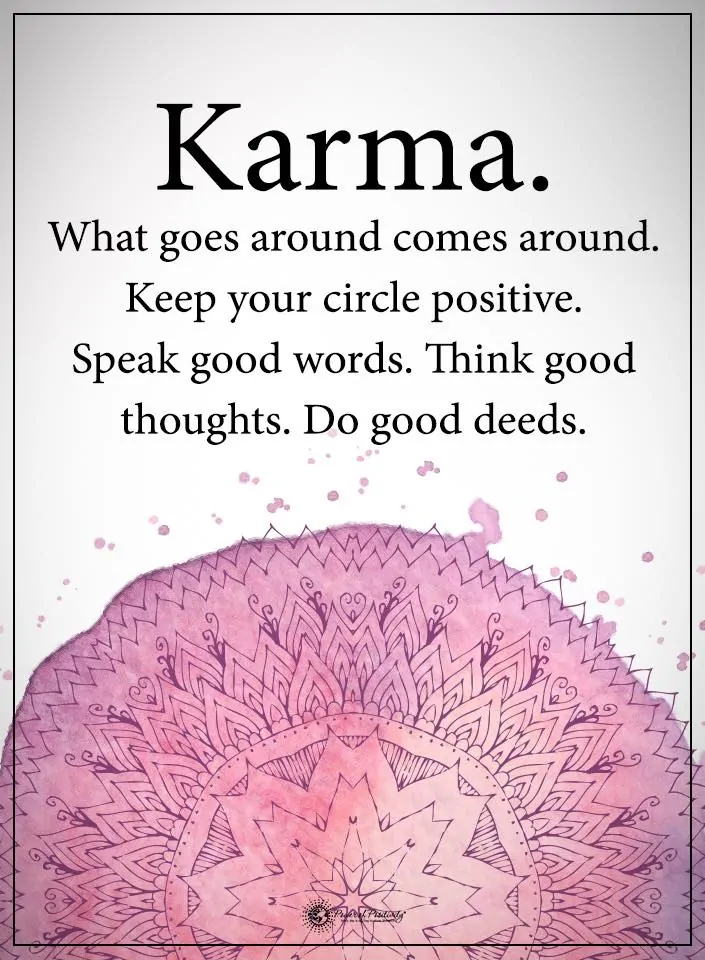
What is Karma?

What is Karma?

September 2026 – Farshad Farahnak. All rights reserved.

There was once a man who betrayed his mafia boss. When the boss found out, he simply said:
“Leave. And never let me see you again.”

The man was shocked. He expected death. Confused and terrified, he fled.

He started over in another city. Slowly built a life. Found work. Married. Had children. Fifteen years passed. Life finally felt good.

Then one day the old boss appeared.
“Remember the day you betrayed me? Today is the day of reckoning. I’ve come for your life.”

The man, trembling, asked:
“Why didn’t you kill me that day?”

The boss answered quietly:
“That day you had no wife. No children. No real life to lose.
Today you do.
Today death will hurt far more — because now you understand what you’re leaving behind.”

Karma works exactly like this.

Sometimes when you do something wrong, life doesn’t punish you right away. It lets you walk away. You start over. You build a career. You get married. You have children. You create a life full of meaning and responsibility. And for years, it feels like the past is behind you.

But karma is patient.
Years can pass. Then, just when everything finally matters — when you have people you love and a life worth protecting — the bill arrives. And this time it hurts far more, because now you understand exactly what you’re about to lose.

This isn’t just a story about the mafia.
It’s about the lies we tell, the people we betray, the responsibilities we abandon, and the harm we cause when we think no one is watching.

Karma rarely comes when you have nothing to lose.
It comes when you finally have everything… and that’s when the price becomes truly heavy.

So if you still have the chance to make something right today — do it.
Some debts become much more expensive when they’re paid late.

Jordan Peterson said once:
“In all my years as a clinical psychologist — and this is something that really does terrify me — I have never seen anyone ever get away with anything at all, even once.

You know, there’s that old idea that God has a book and keeps track of everything in heaven. Okay, maybe it’s not a book. Fine. But that is a really useful thing to think about… because maybe you disagree. Maybe you think people get away with things all the time. I tell you, I’ve never seen it.

What I see instead is that something happens. Someone twists the fabric of reality and they do it successfully, because it doesn’t snap back at them in that moment. And then two years later something unravels and they get walloped, and they think, ‘Oh my God, that’s so unfair.’

And then we track it. It’s like, ‘But what happened before that?’ This. Well then what? This. And then what? This. And then what? Oh… oh, this. Oh, that’s where it went wrong.

Because you can’t twist the fabric of reality without having it snap back. It doesn’t work that way. And why would it? What are you going to do — twist the fabric of reality? I don’t think so. I think it’s bigger than you.

One of the things that really tempts people is the idea that ‘I can get away with it.’ It’s like… yeah, you try.”

Karma is not only about the wrong you do. It is about every action, thought and feeling you put in — good or bad. So if you do the right thing, one day it will return to you and shape your life in a good way.
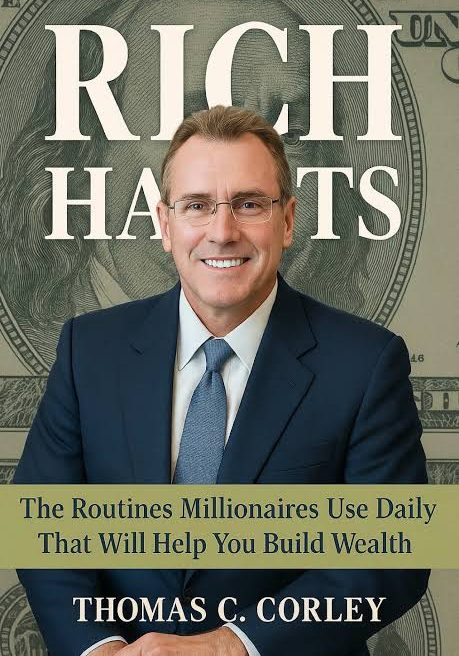

Daily Habits of Millionaires

Thomas C. Corley: The Researcher Who Mapped the Daily Habits of Millionaires

While many people debate whether wealth comes from luck, talent, or inheritance, one researcher spent five years studying what the rich actually do every day—and how those habits differ from people living in poverty.

That researcher is Thomas C. Corley, a CPA, certified financial planner, and author best known for his “Rich Habits” studies.

Who Is Thomas C. Corley?

Corley is a practical, numbers-driven researcher rather than a pure academic. As a financial professional, he became curious about the gap between people who build lasting wealth and those who struggle. Instead of relying on theory, he decided to interview both groups directly and track their daily behaviours over time.

His work resulted in the book Rich Habits: The Daily Success Habits of Wealthy Individuals and several follow-up titles that expanded on the original findings.

The Research

Over five years, Corley interviewed 233 wealthy individuals (177 of them self-made millionaires) and 128 people living in poverty. He gathered more than 340 data points through detailed questionnaires and conversations. The goal was simple: identify the specific habits that consistently separated the two groups.

The results revealed clear, measurable differences in how each group spent their time, money, and attention.

Key Findings

Here are some of the strongest patterns from Corley’s research:

HabitRich / Self-MadePoor
Read for self-education 30+ minutes a day88–96%~2%
Set and review specific goals daily80–95%~12%
Save 20% or more of income94%+Near 0%
Believe wealth comes mainly from habits (not luck)84–97%Only ~21%
Exercise regularlyHighLow
Track finances / balance checkbook monthly94%+~32%

Corley also identified four main paths people took to become millionaires:

  1. Saver-Investor — Consistent saving and prudent investing (average ~32 years to roughly $3.3 million)
  2. Virtuoso — Becoming highly skilled in a valuable field
  3. Big Company Climber — Rising through the ranks of a large organisation
  4. Dreamer-Entrepreneur — Building a business (the fastest path in his data: average 12 years to about $7.4 million)

Other recurring themes included continuous learning, deliberate relationship-building and mentorship, optimism, calculated risk-taking, and steady daily progress on long-term goals.

Why It Matters

Corley’s research is especially useful because it focuses on behaviours most people can start changing immediately. Unlike studies that examine only the ultra-wealthy or pure personality traits, his work highlights everyday disciplines—reading, goal-setting, saving, exercising, and networking—that compound over years.

The message is empowering: wealth is less about secret knowledge or rare talent and more about consistent habits practised over a long period. Many of the millionaires in his study were not flashy high-earners; they simply made better daily choices with their time and money than their peers.

In a world full of get-rich-quick advice, Corley’s findings offer something rarer—a clear, research-backed picture of what ordinary people who became millionaires actually did differently, day after day.

Your Beliefs

A belief is a mental state or acceptance that an idea, thing, or proposition is true, even without absolute proof or direct knowledge. Beliefs act as inner maps that help people make sense of the world, guide everyday choices, and shape personal identity

Your beliefs become your identity. Your beliefs become your prism through which you will see the world and receive information. Your beliefs will filter the information that does not match them.

People often reject facts that conflict with their beliefs because changes feel like a threat to safety and self-image. They grow from repetition, personal background, and lessons from family or society. Deep, firm ideas about oneself, others, and the world are called core beliefs.

Belief

A feeling of certainty that something exists or is true. Nelson Mandela’s belief in equality and justice inspired many people around the world to fight for human rights and strive for a better future.

Faith

Strong trust or confidence in something or someone. Rebecca has a deep faith in the power of kindness.

Conviction

A firmly held belief or opinion. Their shared conviction in the importance of education united them in their efforts to improve schools in their community.

Value

Principles or standards of behaviour. Paul’s strong belief in the value of hard work
and perseverance has always guided his career choices.

Principle

A basic rule or idea that guides how something is done or how someone
behaves. Mark lives by the principle of treating others as he wants to be treated.

Limiting Belief

A limiting belief is a thought, assumption, or conviction that holds you back from reaching your potential, taking action, or achieving what you want.

It acts like an invisible mental barrier. These beliefs are often false, exaggerated, or outdated, yet they feel true and influence decisions, behaviour, and self-image.

Who You Turn To?

When people are happy, they frequently seek out those they are attracted to, excited about, or want to share joy with (the person they “love” or desire). Happiness is expansive and outward-facing for many.

When people are sad, hurt, or vulnerable, they more often turn to people who feel safe, reliable, and unconditionally supportive (the person who loves them). Comfort, acceptance, and low judgment matter more than excitement in those moments.

This pattern shows up in everyday experience and lines up with basic attachment and emotional-regulation ideas: we seek different things from different relationships depending on our emotional state

Gautama Buddha > Quotes

What you think you become.
What you feel you attract.
What you imagine you create.

Holding onto resentment only perpetuates negative Karma. By forgiving others, individuals can break the cycle of negative Karma.

Peace comes from within. Do not seek it without.

No one saves us but ourselves. No one can and no one may. We ourselves must walk the path.

There is no path to happiness: happiness is the path.

Conquer the angry one by not getting angry; conquer the wicked by goodness; conquer the stingy by generosity, and the liar by speaking the truth.

Nothing can harm you as much as your own thoughts unguarded.