
There’s a quiet difference most of us never notice until it costs us something real.
Deep, analytic thinking is deliberate. It examines evidence, weighs possibilities, and then returns to the present so you can act. It ends in a meaningful decision. Deep, analytic thinking works differently. It prioritises structure, evidence, and consequence over emotional colouring. It asks: What actually happened? What is the causal chain? What options remain open? Emotion is not entirely absent — values, motivation, and even a quiet sense of care can guide the inquiry — but it does not hijack the process. Feeling is treated as data rather than as the driver. The mind stays oriented toward reality instead of toward the private theatre of what might have been or what could still be.
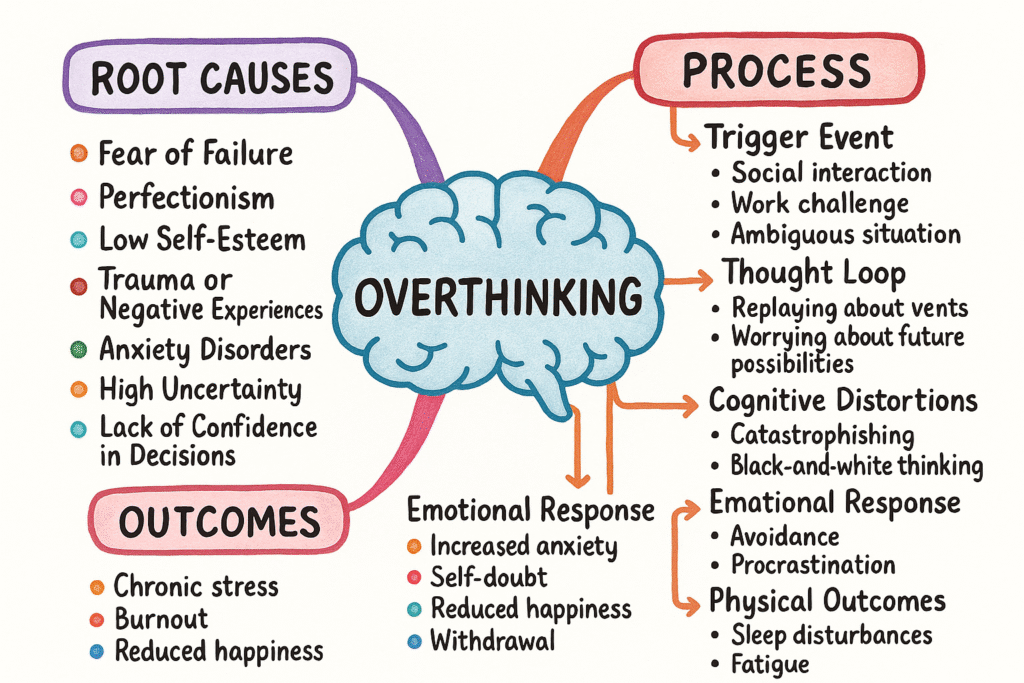
Overthinking is something else entirely. It is looping. It is rehearsal. It is the mind spinning endless versions of what already happened—or what might still happen—until the original event becomes almost unrecognisable. Overthinking is rarely pure thought. It is thought saturated with feeling. The mind doesn’t simply examine an event; it bathes it in emotion — anxiety, regret, longing, imagined triumph, or dread — until the original facts become secondary. The scenarios feel compelling precisely because they are emotionally charged. The loop continues because the feelings keep feeding it. In that sense, overthinking is polluted: logic is present, but it is subordinated to emotional intensity. The result is not clearer understanding but amplified distortion.
So the contrast holds:
- Overthinking = thought + emotional contamination → looping, exaggeration, poor decisions.
- Deep thinking = thought guided by logic and reality-testing → clarity, proportion, better action.
The practical implication is useful. When you notice yourself rehearsing, ask not only “Am I thinking or ruminating?” but also “How much of this is emotion wearing the mask of thought?” That single question often breaks the spell. It returns you to the cooler, more useful mode of mind — the one that can still feel without being ruled by feeling.
You know the pattern. Something occurs: a conversation, a decision, a moment of praise or criticism. Instead of letting it settle, the mind takes possession of it. It builds alternate endings. It invents dialogues you never had. It stages victories in which you finally said the perfect thing and watched others concede. Or it stages defeats in which everything collapses, and you are left exposed. In that private theatre you fight, win, lose, celebrate, and grieve—sometimes all in the same hour. The emotional intensity feels significant. It feels like processing. But it is not. It is consumption.
Like any addiction, it delivers a temporary hit—relief, righteousness, imagined control—while slowly eroding the ground under your feet. The scenarios feel vivid because they are fueled by real emotion, yet they remain fictional. Decisions made from that fog are rarely clear. You react to a story rather than to reality. And because the mind has rehearsed certain reactions so thoroughly, those responses begin to migrate into automatic systems. The next time a similar situation appears, the script runs before you consciously choose. A sharp word, a defensive posture, a withdrawal that no longer matches the actual moment. Life starts answering a version of events that only existed inside your head.
This is not insight. It is distortion with good marketing.
The way out is not to stop thinking. It is to notice the difference between thinking that serves life and thinking that feeds on itself. When the familiar loop begins—when you catch yourself replaying, rewriting, or winning arguments that never happened—pause long enough to ask a simple question: Is this helping me meet reality, or is it keeping me inside a story?
That small act of recognition is already a return. From there you can choose: gather the actual facts, feel the real emotion without embroidery, and then decide what, if anything, needs to be done in the world that exists outside your mind.
Awareness does not eliminate the impulse overnight. The mind is practised at this particular form of self-occupation. But every time you interrupt the loop, you weaken its claim on you. You reclaim the difference between reflection and rumination. You protect the quality of your decisions. And you stop letting imagined battles quietly become real consequences.
The next time the mind starts building its private stage, remember: the most powerful thing you can do is simply refuse to buy a ticket. Step back into the actual moment. That is where your life is still waiting for you—unscripted, unfinished, and still capable of being lived rather than merely rehearsed.